




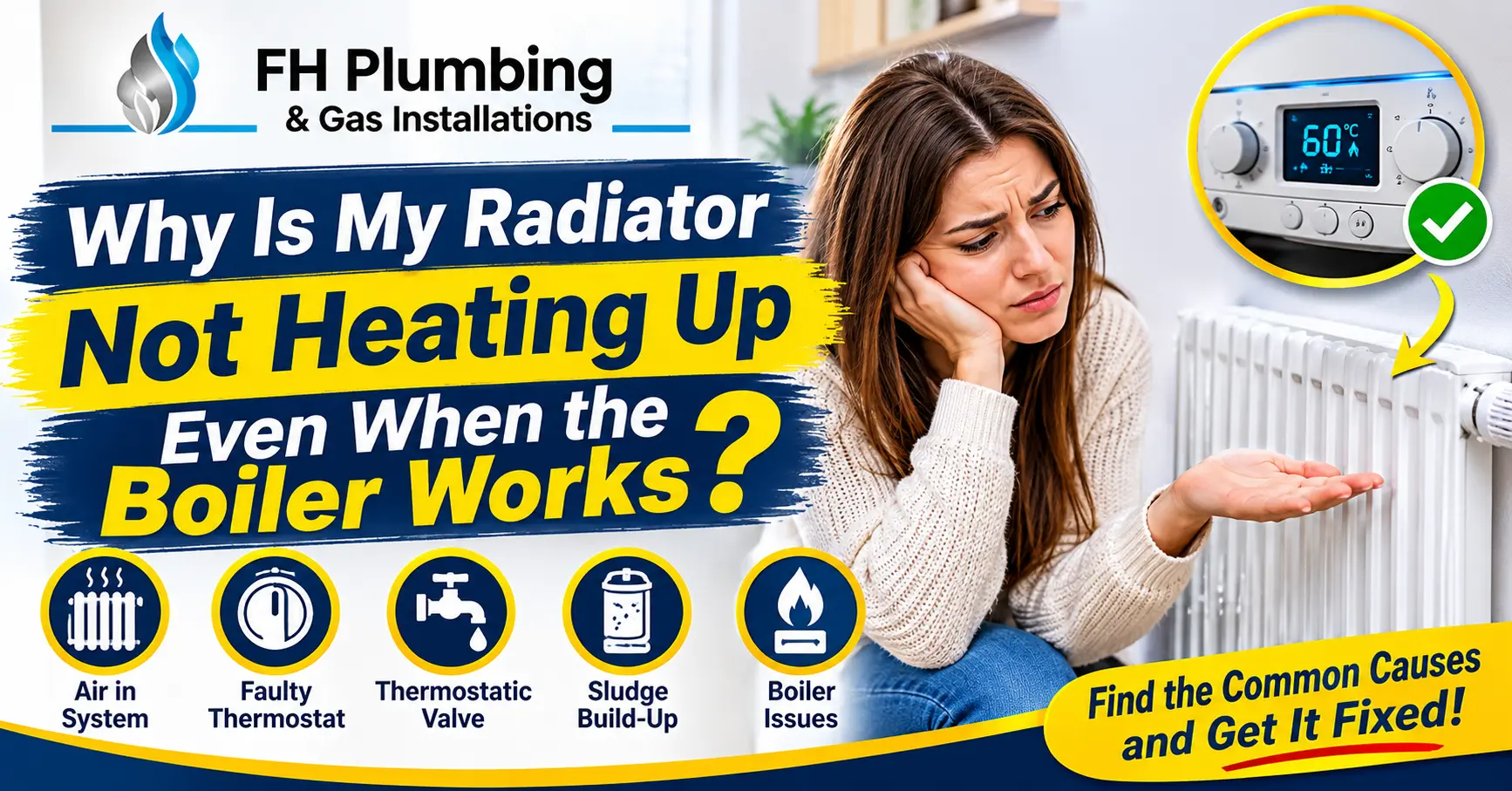
A warm boiler and a cold room make a frustrating combination. If you have a radiator not heating up while the boiler is firing normally, the boiler itself is often not the problem. In most homes, the fault sits somewhere between the boiler and that radiator, such as trapped air, sludge, a stuck valve or poor water circulation.
This guide explains what each symptom usually means, what you can safely check yourself, and when a qualified engineer should take over. It has been prepared by FH Plumbing & Gas Installations, a Gas Safe registered plumbing and heating business based in Woodhouse, Sheffield, for homeowners, tenants and landlords who want clear answers before booking a repair.
Quick Answer: Why Is a Radiator Cold When the Boiler Is On?
A radiator not heating up when the boiler works is usually caused by trapped air, a sludge build-up, a closed or stuck valve, an unbalanced system or a failing pump. Where the cold patch sits gives the best clue. A radiator cold at the top usually points to air, while a radiator cold at the bottom usually points to sludge.
What the Cold Spot Is Telling You
| What you notice | Likely cause | First step |
|---|---|---|
| Hot at the bottom, cold at the top | Trapped air | Bleed the radiator |
| Hot at the top, cold at the bottom | Sludge | Ask an engineer to check the system |
| One radiator cold, the rest hot | Closed or stuck valve | Check both radiator valves |
| Radiators far from the boiler are cooler | Unbalanced system | Have the system balanced |
| Every radiator cold, boiler running | Pump or valve fault | Call an engineer |
Common Causes of Radiator Heating Problems
Once you know where the cold patch sits, finding the reason for a radiator not heating up becomes much easier. Most radiator heating issues come down to one of six faults. Some take minutes to fix, while others need a proper diagnosis.
Trapped Air
Air rises, so it collects at the top of the radiator and stops hot water filling the panel. This is one of the most common reasons for a radiator not warming up, especially when the heating comes back on after summer. You may also hear gurgling from the pipes or the radiator itself.
Sludge Build-Up
Over time, rust and debris mix with the heating water to form a dark sludge. It settles along the bottom of the panel and blocks the flow, which is why the lower half stays cool. Several cold radiators across the house can suggest that sludge has spread through the system. Depending on how severe it is, an engineer may recommend a chemical clean, a power flush or a magnetic filter.
Closed or Stuck Valves
Each radiator normally has two valves: a thermostatic radiator valve (TRV) or manual valve on one side, and a lockshield valve on the other. If either one is closed, hot water cannot pass through. A TRV pin can also stick after months without use, which leaves one radiator not getting hot while the rest of the house stays warm.
An Unbalanced System
Hot water takes the easiest route. As a result, radiators closest to the boiler can take more than their share, while those furthest away stay lukewarm. This uneven radiator heating often shows up at the far end of the house. Balancing the system means adjusting the lockshield valves so that each radiator receives the right flow.
Low Boiler Pressure
Most sealed heating systems should read between 1 and 1.5 bar when the heating is off. Low pressure can stop water circulating properly, and many boilers will shut down to protect themselves. If the pressure keeps falling, there may be a leak or a failing component that needs attention.
Pump or Valve Faults
When every radiator stays cold while the boiler fires, the cause may be a failing pump, a stuck diverter valve or a faulty motorised valve. A central heating radiator not working in every room is rarely a simple fix, so this is a job for an engineer.
How to Fix a Radiator Not Heating Up: Safe Checks to Try First
Work through these steps in order. Turn the heating off and let the system cool before you touch or bleed a radiator.
- Check the controls. Make sure the thermostat is set above room temperature and the timer is calling for heat.
- Check the valves. Turn the TRV to its highest setting, then check that nobody has closed the lockshield valve.
- Find the cold spot. With the heating running, carefully feel the radiator to see whether the top, the bottom or the whole panel is cold.
- Bleed the radiator. With the heating off, hold a cloth under the bleed valve, open it slowly with a radiator key, and close it as soon as water appears.
- Check the pressure. Bleeding releases a little water, so look at the boiler gauge. If it is below 1 bar, follow your boiler manual to top it up.
- Test it again. Turn the heating back on and check the radiator once the system has warmed up.
These checks cover the simple faults. If you still have a radiator not heating up after bleeding it, stop there. Do not remove the radiator, force a stuck valve or open the boiler casing.
When to Call a Professional
Bring in an engineer if any of the following apply:
- More than one radiator stays cold after bleeding
- The same radiator needs bleeding every few weeks
- The boiler pressure keeps dropping
- Water is leaking around a valve or pipe
- The boiler shows a fault code or makes unusual noises
- Every radiator is cold while the boiler runs
Any work on the boiler itself must be carried out by a Gas Safe registered engineer. If the fault points to the boiler, our boiler repairs in Sheffield page explains how we can help. For a leak or a complete loss of heating, you can reach our emergency plumbers in Sheffield at any hour.
At FH Plumbing & Gas Installations, our engineers diagnose the cause first and explain it in plain English. You receive a free quote before any work goes ahead, and there is no call-out fee.
If you ever smell gas, leave the radiators alone. Turn off the gas at the meter, open the windows, avoid switches and flames, and call the National Gas Emergency Service on 0800 111 999.
How to Prevent Radiator Problems
A little regular care can stop most faults from returning:
- Book an annual service. A yearly boiler service helps catch pressure and component problems early.
- Test the heating in early autumn. You will then find a radiator not heating up before the cold weather arrives.
- Move your TRVs in summer. Opening and closing them occasionally can help stop the pins sticking.
- Watch the pressure gauge. A small, repeated drop is an early warning sign.
- Ask about a magnetic filter. It captures debris before it can settle in your radiators.
Landlords should act quickly when a tenant reports a radiator not heating up. The repair visit can often be planned alongside the annual landlord gas safety check.
Frequently Asked Questions
Why is my radiator not heating up when the others are hot?
When only one radiator is cold, the cause is usually local. Trapped air, a closed valve, a stuck TRV pin or sludge inside that radiator are the most likely reasons. Start by checking both valves, then bleed it.
Why is my radiator cold at the bottom but hot at the top?
This usually means sludge has settled along the bottom of the panel. Bleeding will not clear it, so ask an engineer to inspect the system.
Why is my radiator cold at the top but hot at the bottom?
This usually means air is trapped inside. Bleeding the radiator normally solves it. If the problem returns quickly, have the system checked.
Can I bleed a radiator myself?
Yes. Most homeowners can do this safely with a radiator key, as long as the heating is off and the system has cooled. Remember to check the boiler pressure afterwards.
Will a boiler service fix cold radiators?
Not always. A service focuses on the boiler, so it may not clear sludge or balance the system. However, the engineer can often advise on what is causing the problem.
Conclusion: Get Your Heating Working Evenly Again
A radiator not heating up is rarely a sign that you need a new boiler. In many cases, the position of the cold spot points straight to the cause, and simple checks such as bleeding the radiator or opening a valve can restore the heat.
If the problem returns or more than one room is affected, it is best to have the whole system looked at. To arrange a visit, contact FH Plumbing & Gas Installations or call 07853 958388. Finding the cause early can help you avoid a bigger repair and keep every room warm through the winter.