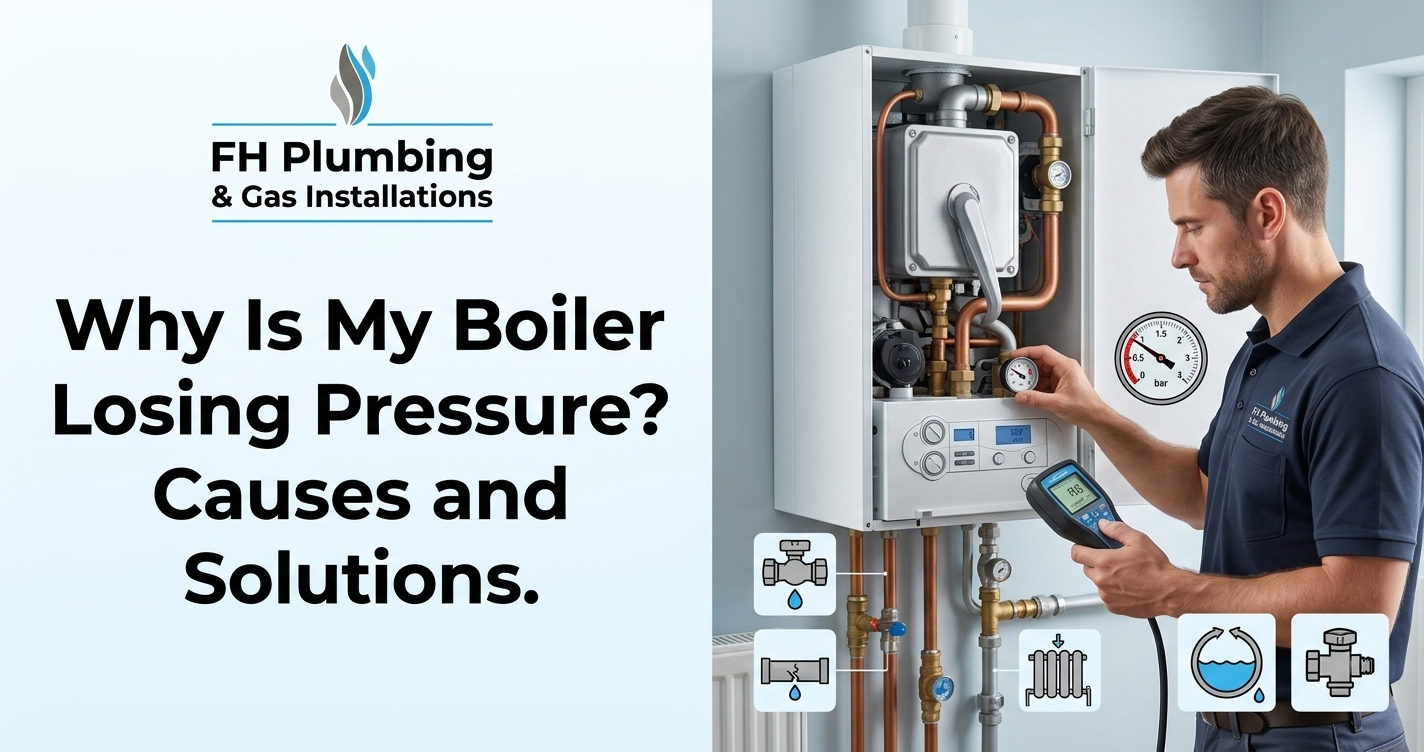

You top up the pressure, the heating works for a few days, and then the gauge drops again. If your boiler keeps losing pressure, it is telling you that water is escaping from the system or that a part is no longer doing its job. Topping it up treats the symptom, but it does not fix the cause.
This guide explains what normal boiler pressure looks like, the most common reasons it falls, how to repressurise a boiler safely, and when the problem needs an engineer. It has been written by FH Plumbing & Gas Installations, a Gas Safe registered plumbing and heating business based in Woodhouse, Sheffield, to help homeowners and landlords understand the problem before they book a repair.
Quick Answer: Why Does a Boiler Keep Losing Pressure?
A boiler keeps losing pressure for one of five main reasons: a water leak in the pipework or radiators, a faulty pressure relief valve, an expansion vessel that has lost its air charge, air released after bleeding radiators, or an internal leak inside the boiler. Small topping-up is normal after bleeding, but a pressure drop that keeps returning usually needs a professional diagnosis.
What Is Normal Boiler Pressure?
Most sealed heating systems, including combi and system boilers, should read between 1 and 1.5 bar when the heating is off. When the heating is running, the pressure naturally rises a little, often to around 2 bar, because water expands as it warms.
| Gauge reading | What it usually means | What to do |
|---|---|---|
| Below 1 bar | Pressure is too low | Repressurise, then watch the gauge |
| 1 to 1.5 bar (cold) | Normal | No action needed |
| Around 2 bar (hot) | Normal while heating | No action needed |
| 2.5 to 3 bar or above | Pressure is too high | Call an engineer |
Low boiler pressure problems often show up as radiators that will not heat, no hot water, or a fault code on the display. Many boilers lock out below about 0.5 bar to protect themselves.
Common Causes of a Boiler That Keeps Losing Pressure
1. A Water Leak in the System
A leak is the most common reason a boiler pressure keeps dropping. Water can escape from radiator valves, pipe joints, the towel rail or the boiler itself. Some leaks are obvious, while others are tiny drips that evaporate before you notice them.
Look for:
- Damp patches or staining on ceilings and walls
- Rust or white limescale marks around radiator valves
- Drips under the boiler casing
- Warm or discoloured patches on floors
2. A Faulty Pressure Relief Valve
The pressure relief valve releases water if the pressure climbs too high. Over time, debris can stop it closing fully, so it lets water out even at normal pressure. Boiler pressure relief valve problems are often easy to spot: check the small copper pipe that runs from the boiler to the outside wall. If it is dripping or leaves a wet patch below, the valve may be passing water.
3. Boiler Expansion Vessel Issues
The expansion vessel absorbs the extra volume of water when the system heats up. Inside it, a cushion of air does the work. When that air charge is lost, the pressure jumps when the heating comes on and the relief valve releases water. Then, as the system cools, the pressure falls lower than before.
So if your boiler pressure drops when heating is on and off in a repeating up-and-down cycle, the expansion vessel is a likely suspect. Recharging or replacing the vessel is a job for an engineer, because it usually involves working inside the boiler casing.
4. Bleeding Radiators
Bleeding a radiator lets out trapped air, but it also releases a little water. As a result, a small drop in pressure afterwards is normal. Top the system back up once and keep an eye on it. If the pressure keeps falling after that, there is another cause.
5. An Internal Boiler Leak
Seals, the heat exchanger and internal pipework can wear or corrode with age. Water from an internal leak may not be visible because it sits inside the casing. Only a Gas Safe registered engineer should remove the casing to investigate.
Boiler Losing Pressure Overnight: What It Means
A boiler losing pressure overnight, when the heating is off, usually points to a slow leak somewhere in the system. Because nothing is running, the water loss has nothing to do with heat or the expansion vessel. In contrast, a drop that only happens while the heating runs is more likely to involve the expansion vessel or the relief valve.
Writing down the gauge reading morning and evening for a few days gives your engineer a useful clue and can speed up the diagnosis.
Combi Boiler Pressure Drops: Is It Different?
Combi boiler pressure drops follow the same rules as a system boiler, because both use a sealed heating circuit. However, combi boilers have the expansion vessel and the relief valve built inside the casing, which makes these parts harder to check yourself. If your combi boiler keeps losing pressure and needs topping up more than once every few months, it is worth booking an inspection.
How to Repressurise a Boiler Safely
Always check your boiler manual first, as the steps vary by model. In general:
- Turn the boiler off and let the system cool.
- Find the filling loop. This is usually a silver braided hose with a valve at each end under the boiler, or a built-in tap or key on some models.
- Open the valves slowly. You will hear water entering the system.
- Watch the gauge. Stop when it reaches 1 to 1.5 bar.
- Close both valves fully. A valve left slightly open can push the pressure too high.
- Turn the boiler back on and reset it if the display asks you to.
If your boiler keeps losing pressure and you need to repeat this regularly, stop topping up and arrange a repair. Adding fresh water again and again also brings in oxygen, which can speed up corrosion inside radiators.
Boiler Pressure Leak Detection: What an Engineer Checks
When a homeowner tells us their boiler keeps losing pressure, our engineers follow a set process:
- Visual inspection of the boiler, valves, radiators and exposed pipework
- Relief valve check to see whether water is passing to the outside pipe
- Expansion vessel test to measure its air charge
- Pressure test to confirm whether the system holds pressure when isolated
- Internal inspection of seals and the heat exchanger where needed
This step-by-step approach finds the true cause of central heating system pressure loss, rather than replacing parts on guesswork.
When to Call a Professional
Contact an engineer if:
- You need to top up more than once every few months
- The pressure rises above 2.5 bar when the heating is on
- Water is dripping from the outside copper pipe
- You can see a leak but cannot find its source
- The boiler shows a fault code or keeps locking out
At FH Plumbing & Gas Installations, our Gas Safe registered engineers diagnose the cause first and explain it in plain English. You receive a free quote before any work goes ahead, and there is no call-out fee. If water is leaking into your home, call our 24/7 emergency plumbers in Sheffield straight away.
If you ever smell gas, turn off the supply at the meter, open the windows, avoid switches and flames, and call the National Gas Emergency Service on 0800 111 999.
How to Prevent Pressure Problems
- Book an annual service. A yearly boiler service includes checks on the pressure, expansion vessel and relief valve.
- Check the gauge monthly. Catching a slow drop early can prevent a breakdown.
- Fix small leaks quickly. Even a weeping valve can empty the system over time.
- Consider the boiler’s age. If an older boiler needs repeated repairs, a boiler replacement may be the better long-term choice.
Frequently Asked Questions
Is it dangerous if my boiler keeps losing pressure?
Low pressure is not usually dangerous in itself, but it stops the boiler working properly. However, the leak causing it can damage ceilings, floors and electrics, so it should be found and fixed.
How often should I need to top up my boiler pressure?
In a healthy system, rarely. Topping up after bleeding radiators is normal. If your boiler keeps losing pressure every few weeks, there is a fault to find.
Can I fix a pressure relief valve myself?
No. The relief valve is a safety device connected to the boiler, so it should only be repaired or replaced by a Gas Safe registered engineer.
Why does my boiler pressure rise and then fall?
This pattern usually means the expansion vessel has lost its air charge. The pressure climbs when the water heats, the relief valve releases the excess, and the pressure then drops when the system cools.
Will a boiler service stop pressure loss?
A service can catch early problems, such as a weak expansion vessel. However, an active leak needs a repair rather than a service.
Conclusion
When a boiler keeps losing pressure, it is a clear sign that something in the system needs attention. Repressurising will restore the heating for now, but the drop will return until the leak, valve or expansion vessel is fixed.
Keep a note of how quickly the pressure falls, check the outside copper pipe, and look for damp patches. Then, if the problem continues, contact FH Plumbing & Gas Installations on 07853 958388. A quick diagnosis now can prevent water damage and a bigger repair bill later, especially if your boiler keeps losing pressure through the colder months.